
Unstitched suits · 8 October 2026 · 3 min read
How much fabric for an angrakha kameez?
How much fabric for an angrakha: typical metres for a wrap kurta, a knee-length angrakha and a flared angrakha frock, and why the overlapping front adds to it.
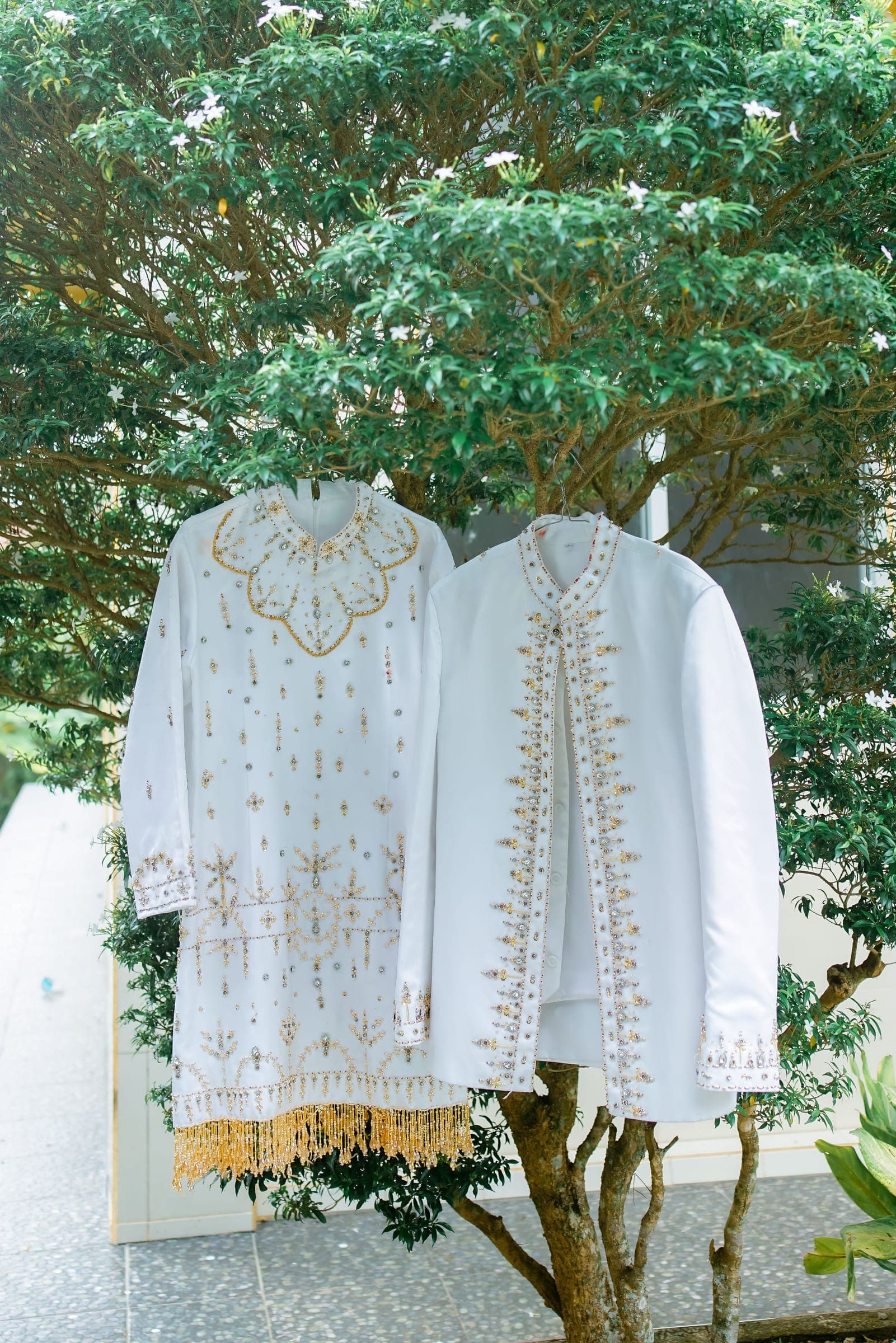 Inspiration
A little more than a plain kameez
A knee-length angrakha kameez usually needs about 2.75 to 3.25 metres (3 to 3.5 yards) of 44 to 45 inch fabric, around a quarter to half a metre more than a plain straight kameez, because the front is cut as two overlapping panels. An angrakha frock with a flared skirt needs much more: often 4 to 5 metres at calf length and 5.5 metres or more to the floor.
These are typical figures with full sleeves for a woman of average height. Your length, size and the flare you choose decide the real amount, which we confirm in your quote.
Where the extra fabric goes
On a plain kameez the front is one piece. On an angrakha it is two, and each one is wider than half the front, because the panels cross over the chest by about 10 to 20 cm (4 to 8 inches) and tie at the side. That overlap is the main extra cost. The curved wrap edge also needs a facing or binding strip along its whole length, and the ties need a little more.
Many angrakhas go further and are cut as a fitted bodice joined to a flared skirt. Then the skirt becomes a separate set of panels, and the flare, not the wrap, decides most of the total. Our angrakha style page shows both versions.
Typical amounts by length and shape
Each line gives 44 to 45 inch fabric first, with 58 to 60 inch fabric in brackets.
- Angrakha kurti to the hip: 2 to 2.5 m, about 2.2 to 2.75 yards (1.5 to 1.75 m).
- Knee-length angrakha, straight or slightly A-line: 2.75 to 3.25 m, about 3 to 3.5 yards (2 to 2.5 m).
- Calf-length angrakha frock, flare about 3 to 4 m: 4 to 5 m, about 4.4 to 5.5 yards (3 to 3.75 m).
- Floor-length angrakha frock, flare 5 m or more: 5.5 to 7 m, about 6 to 7.7 yards (4.25 to 5.5 m).
Working it out from your own length
For the frock style, split the sum. The bodice and sleeves usually take about 1.25 metres of narrow fabric. For the skirt, measure from the bodice seam to the hem and add about 8 cm. If the skirt is gathered from straight panels, divide the flare you want by roughly 1.08 metres (what one width of 44 inch fabric gives after seams), round up, and multiply by the skirt depth.
Take a calf-length angrakha with the seam at the waist. A skirt depth of 75 cm plus 8 cm is 83 cm. A flare of 3.5 metres needs four widths, so the skirt takes about 3.3 metres, and the whole frock about 4.6. If the skirt is cut from tapered panels (kalis) instead, they can be laid top to tail and the total drops, as our kalidar frock page explains. Our guide to fabric widths shows why wider cloth needs fewer metres.
Using a printed suit for an angrakha
The kameez piece in an unstitched suit, often around 2.5 to 3 metres, can be enough for a straight angrakha but rarely for a flared frock. Plain matching fabric for the skirt panels or sleeves is a common fix. Borders matter too: a hem border has to run round the hem, and a one-way print has to face the same way on both crossing panels, which can add a little. Our article on fabric for a three-piece suit gives the starting figures for a standard kameez.
For pairing ideas, see what to wear with an angrakha. When you are ready, send a picture through the design quote form, or ask us to supply the fabric with Fabric + Stitching. We confirm the quantity and the design in writing before anything is cut.
Common questions
Does an angrakha need lining?
Not always. Opaque cotton and cambric are often left unlined, though the bodice may be lined so the overlap sits flat. Sheer fabrics need a lining or a separate slip, which adds lining fabric to the total.
Which side should the wrap close on?
Either works, and both are traditional. Tell us which side you prefer in your notes, and whether you want the ties visible at the side or hidden on the inside.
Is a wrap kurta the same as an angrakha?
They are close relatives. Wrap kurta is often used for any kurta with crossing front panels, while angrakha usually means the traditional curved overlap with ties, sometimes with a flared skirt. The fabric sums work the same way.
