
Embroidery and fancy work · 5 October 2026 · 4 min read
What is schiffli embroidery on lawn?
What is schiffli embroidery? All-over machine embroidery and eyelet work on lawn, how it differs from hand chikankari, and what it means for lining and cutting.
 Inspiration
Schiffli in two sentences
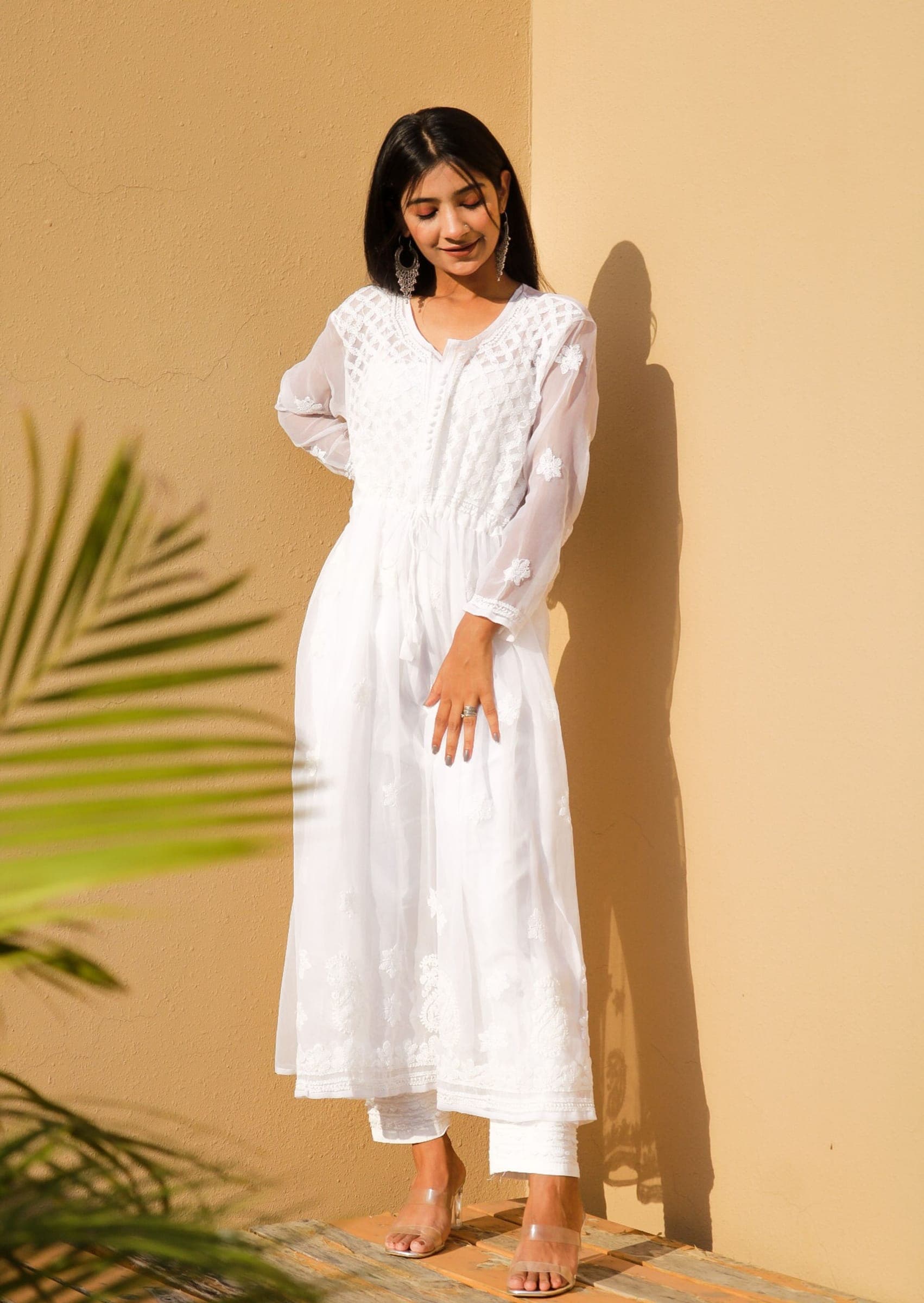
Schiffli is machine embroidery worked across the full width of a fabric by a long row of needles, which is how a length of lawn comes to be covered from edge to edge in stitched flowers, eyelets and scalloped borders. On a Pakistani lawn label, the word tells you the cloth was embroidered all over before it was cut, as opposed to printed, or embroidered only on a separate neck panel.
Where the name comes from
The schiffli machine was developed in Switzerland in the 1860s, and its name is Swiss German for “little boat”, after the boat-shaped shuttle that carries the thread on the back of the cloth. Each needle at the front forms a lockstitch with its own shuttle behind, while the fabric is held taut in a tall frame that moves to trace the pattern.
The same method produces eyelet fabric, known in English as broderie anglaise, where small holes are pierced and their edges bound with stitches. Today the word is used loosely. Lawn sold as schiffli may come from a true schiffli machine or from modern multi-head machines, and in a shop it mostly describes the look: all-over embroidery that usually includes eyelets.
Schiffli vs chikankari
Schiffli lawn is often sold as chikankari lawn or chikan fabric, because white-on-white flowers and eyelets recall the hand embroidery of Lucknow. They are different things. Hand chikankari takes far longer and is valued accordingly, so a listing should say plainly which one it is; our chikankari guide describes the hand stitches.
- How it is made: chikankari is worked by hand with a needle. Schiffli is machine work from start to finish.
- Repeats: schiffli motifs are identical along the whole length. Hand work varies slightly from flower to flower.
- Shadow effect: chikankari’s shadow work is stitched on the reverse so that it shows softly through sheer cloth. Schiffli stitching sits on the surface.
- Openwork: chikankari jaali eases the threads apart without cutting them. Schiffli eyelets are pierced holes with a stitched rim.
- The reverse: schiffli shows even rows of machine stitching and sometimes trimmed thread ends between motifs.
What it means for lining
Eyelets are real holes, and the lawn between them is fine, so a schiffli kameez is more see-through than printed lawn of the same weight. Most people line the body or wear a slip underneath. A lining in the same colour keeps the look quiet, a skin-tone lining lets the eyelets fade into the background, and a contrast lining, such as a pastel under white, turns the eyelet pattern into a feature.
Sleeves are often left unlined so the outfit stays airy, and trousers are normally cut from plain cotton or cambric, not from the embroidered cloth. Our guides to whether a kameez needs lining and choosing lining for an unstitched suit go through fabrics and colours.
What it means for cutting
Schiffli has to be cut with the embroidery in mind, not only the measurements. Check the label first: some suits give embroidered cloth for the whole kameez, others only for the front, with a plain back and sleeves.
- Scalloped edges: many schiffli lengths have a finished, scalloped border along one or both edges. It can become the daman or the sleeve ends, but that fixes the length there, because a scalloped hem cannot be turned up later. Decide your kameez length before anything is cut.
- Motif placement: a row of motifs should run down the centre front, and the two sleeves should mirror each other. Placing pieces for the pattern uses more cloth than cutting plain fabric.
- Seams and darts: stitching through dense embroidery is bulky, and an eyelet that lands on a seam line can gape.
- Shrinkage: embroidery thread and cotton lawn can shrink by different amounts, which puckers the cloth round the motifs. A cool, gentle wash keeps it to a minimum.
Having schiffli lawn stitched
If you already own a schiffli suit, Stitching Only is the route. Send photos of the fabric, including any scalloped edge, with the lengths from the label, and we confirm that it is suitable and that there is enough for your design before you post it to Pakistan. Say where you want the scallops to fall and whether you want a lining. You can start a Stitching Only quote with the photos you have.
If you would like us to supply an embroidered lawn of this kind, describe the look or send a photo, and the written quote confirms what is possible; no particular fabric is promised in advance. For embroidery added to plain lawn instead, see how much embroidery lawn can carry and the custom embroidery page.
Common questions
Is schiffli embroidery done by hand?
No. Schiffli is machine embroidery, named after the shuttle machines that first produced it. If a listing describes all-over eyelet lawn as hand embroidered, ask for a close photo of the reverse before you buy.
Does a schiffli lawn kameez need lining?
Usually, for the body at least. The eyelets are open holes and the lawn itself is fine, so a lining or a separate slip keeps it modest.
Can schiffli lawn go in the washing machine?
Follow the label first. Where machine washing is allowed, use a cool, gentle cycle with the kameez inside out in a mesh laundry bag, because eyelets can catch on hooks and zips. Hand washing is kinder to the stitched rims of the holes.
