Embroidery and fancy work · 5 October 2026 · 3 min read
Embroidery on lawn: how much can the fabric carry?
Embroidery on lawn fabric: what fine lawn carries comfortably, why dense fills pucker or show through, and how backing, lining and placement help.
 Inspiration
How much lawn can carry
Fine lawn carries light and medium embroidery comfortably: outlines, small flowers, scattered motifs and narrow borders at the neckline, cuffs and hem. Dense, solid fills over large areas are where it struggles. The cloth can pucker, the back of the work can show through to the front, and the embroidered patch loses the drape that makes lawn pleasant to wear.
What sits comfortably on lawn
The common factor is open ground. As long as plain cloth separates the stitched areas, lawn stays soft and cool.
- Outline and stem stitches: vines, tendrils and the edges of petals, with the cloth showing between them.
- Small satin-stitch flowers and leaves: each one only a few stitches wide.
- Scattered motifs: spaced so the fabric still moves between them.
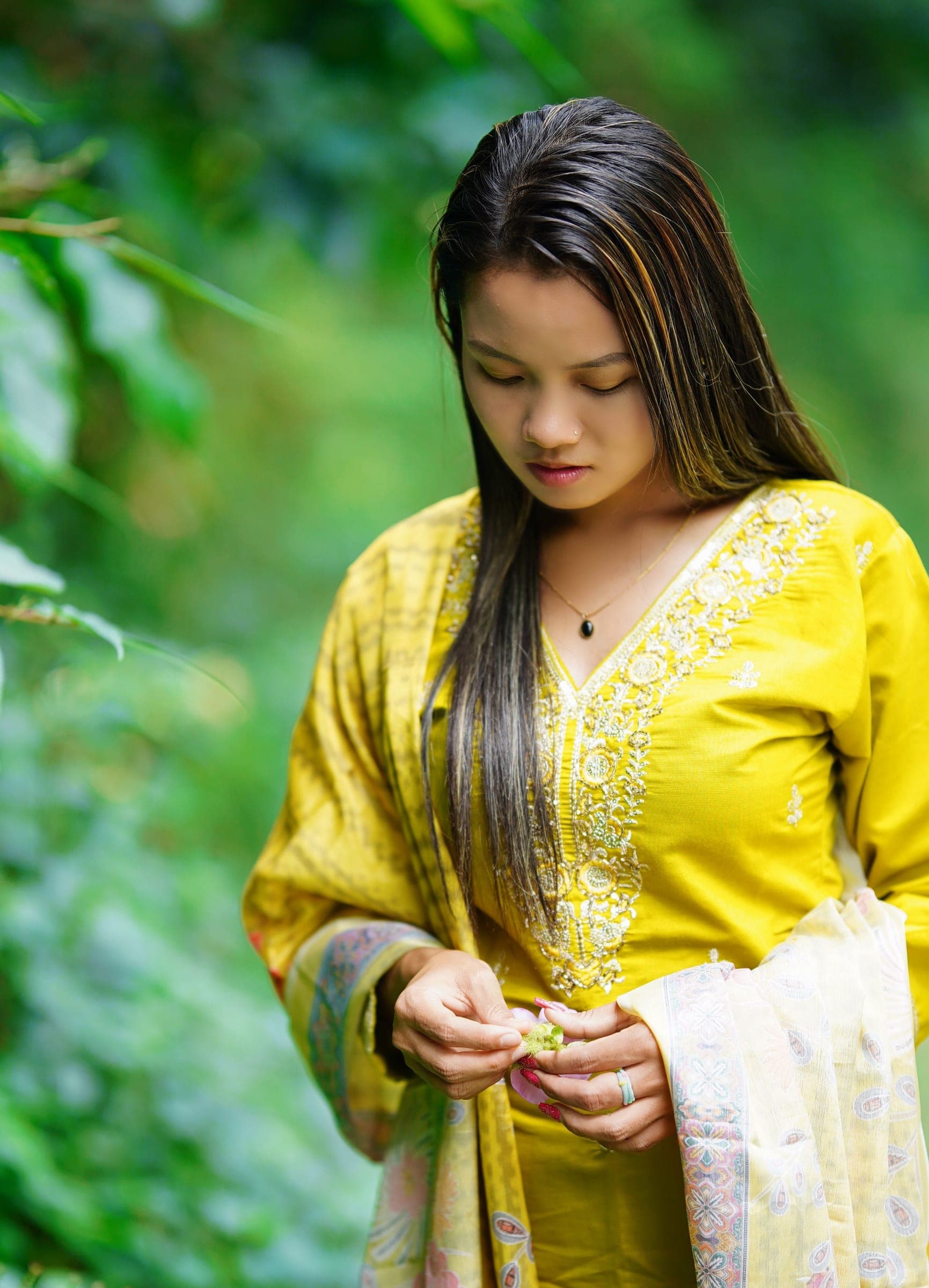
- Narrow borders on doubled edges: the neckline, the placket, the cuffs and the hem all have a second layer of cloth behind them that helps carry the stitching.
- Tonal thread: white on white or a shade taken from the print, which also hides small irregularities.
Where dense work goes wrong
- Puckering: closely packed stitches pull the fine threads of the cloth towards each other, and the fabric gathers round the motif. It often gets worse after the first wash, when cotton shrinks slightly and polyester thread does not.
- Show-through: lawn is slightly sheer, so thread ends, connecting stitches and the backing behind the embroidery can appear as shadows on the front. Dark thread on white lawn is the hardest case.
- Stiff patches: a solid block of stitching hangs like card inside a floating fabric, and it is warmer against the skin.
- Weak edges: needle holes packed closely along the rim of a heavy motif can strain a fine weave over time.
How backing, lining and placement help
None of this means lawn has to stay plain. It means richer work needs support.
- Backing during embroidery: a stabiliser behind the cloth takes the strain while it is stitched. Soft or wash-away kinds suit lawn.
- Lighter designs: the same motif can be drawn with fewer stitches and more open space.
- Supported placements: keep the heaviest work on a faced neckline, a lined yoke, the cuffs or the hem.
- Lining: a lining or half lining behind an embroidered front hides the reverse, stops it scratching and shares the weight. See our embroidery and lining guide.
- Separate bands: a rich border can be embroidered on a firmer strip and then stitched to the hem or sleeve, which is how many ready-embroidered suits handle it. Our guide to what is inside an embroidered lawn pack shows those pieces.
- A firmer cotton: for a heavily worked front, cambric carries more than lawn and looks similar.
Planning embroidery on plain lawn with us
On the quote form, delicate and detailed are the natural levels for lawn. Statement work can be asked for, but on a fabric this fine it usually means borders, bands and a lining, not a solid embroidered front. Tell us whether the lawn is plain or printed, and send a photo of the look you want.
Embroidery can be planned on a lawn outfit we stitch, or worked on your own plain lawn before it is made up, as described in embroidering plain fabric before stitching. Lawn that was embroidered all over at the mill is a different thing; see schiffli embroidery. No technique is promised in advance: the written quote confirms what is possible on your fabric and design. The custom embroidery page explains both routes, and you can request a quote with your photos.
Common questions
Why does embroidery pucker on lawn?
The stitches pull the fine threads of the fabric together, and the denser the design, the stronger the pull. Lawn is too light to resist it without help. Backing during embroidery, a more open design and washing the fabric beforehand all reduce it.
Can heavy embroidery be done on lawn?
In limited areas and with support, yes. A neckline with a facing, a cuff or a hem band can carry rich work. A large solid panel on unlined lawn tends to pucker and hang stiffly, so a firmer fabric or a lining is usually suggested.
Can puckered embroidery be ironed flat?
Mild puckering often eases if you press the area face down on a thick towel while it is slightly damp. Puckers caused by a very dense design are stitched in and will not press out completely.