Unstitched suits · 8 October 2026 · 4 min read
Embroidered neck and hem on one panel: can length change?
An embroidered front panel worked at both neck and hem has a fixed length between them. Where length can still be taken out or added without cutting the work.
 Inspiration
Only in a few places
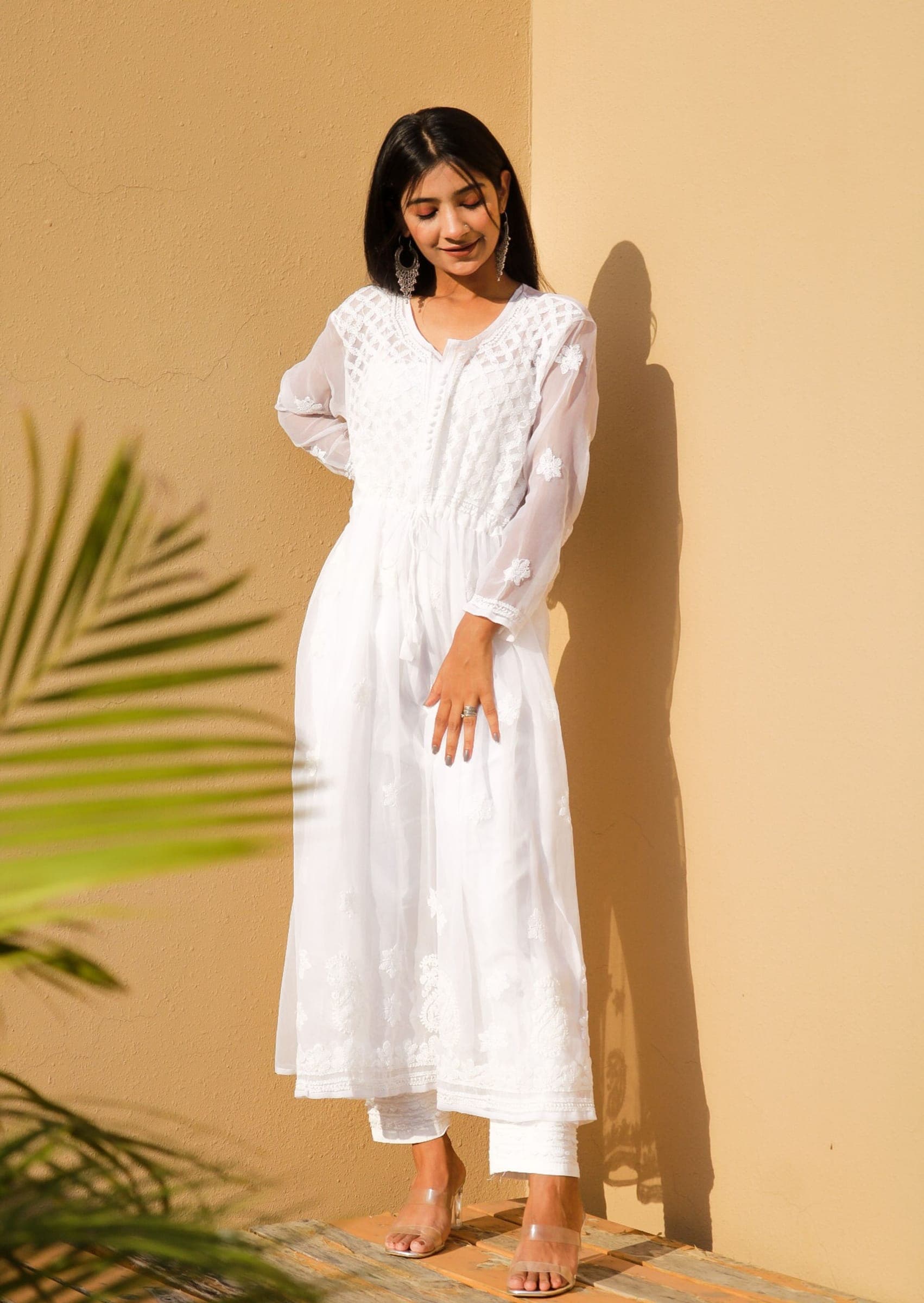
Yes, but not freely. When one front panel carries embroidery at the neckline and at the hem, the distance between the two was fixed when it was embroidered, usually for an average height. Length can still be taken out of the plain stretch in the middle with a horizontal join, or added below the hem work with a band, but the neckline and hem embroidery themselves cannot move closer together or further apart.
Separate daman borders are a different case: they can be sewn at any height, as our article on using neckline pieces and borders from a pack explains. This one is about fronts where both areas are worked on the same piece of cloth.
Measure the panel first
Lay the front flat and measure from the top of the neckline embroidery, or the marked shoulder line if there is one, down to the bottom edge of the hem work. Compare that number with the kameez length you want. Our guide to kameez length for your height helps if you are not sure what that should be.
If the two numbers are within a few centimetres of each other, a small adjustment at the shoulder or hem is often enough. If the panel is much longer or shorter than you need, one of the options below is needed, and it is worth knowing which before you post the fabric. A list of what came in the pack, as in what’s inside an embroidered lawn pack, helps too, since spare plain fabric opens up more choices.
Taking length out
Shortening is the more common request, especially for petite women whose kameez would otherwise reach the calf. The usual options run from least to most visible.
- Trim below the hem work: only possible if there is plain fabric under the embroidery, and only by that amount.
- Raise the shoulder slightly: a small amount can come off the top, but the neckline shape follows the embroidery, so this rarely gives more than a little.
- A horizontal join across the plain middle: a strip is cut out between the two worked areas and the panel is sewn back together. On plain or finely printed fabric the seam is quiet; covered with piping or a narrow lace it becomes a detail.
- Make the join a design line: a seam just under the bust or at the waist, with a little gathering below it, turns the shortening into a frock-style shape.
Adding length
For tall women the panel can be too short, and length can only be added where there is no embroidery. The back and sleeves can be cut to any length, but they have to match the front hem, so the front decides. These are the usual ways to add to it.
- A band below the hem work: an organza panel, a lace or a plain strip in a matching shade. See daman with organza and daman with lace for the look.
- An insert across the middle: a strip of matching plain fabric joined in between the two worked areas, which needs spare fabric of the same kind.
- A longer under-layer: a plain slip or lining that shows below the hem, which suits sheer fronts.
Planning it with us
Send a photo of the front laid flat beside a tape measure, the panel length you measured and the finished length you want. With Stitching Only, we look at the panel and the rest of the fabric and say which option fits before you post it. Use the Stitching Only quote form and note the panel length there.
The option we agree, and where any join will sit, is written into the quote before cutting, so nothing is decided on the day the fabric is cut.
Common questions
Will a join across the middle of the front show?
On plain fabric it shows as a fine straight line, which many people do not notice under a dupatta. Covering it with piping or narrow lace makes it look deliberate. On a large print it depends on how well the print can be matched.
Can the neckline embroidery be moved lower on the panel?
No. The neck shape is worked into the cloth, so it cannot move without cutting the embroidery out. The adjustment has to happen elsewhere.
Does the same apply to a printed front panel?
Mostly, although a print has no raised work, so a join or insert in a printed area can be planned more freely than one next to embroidery.