Embroidery and fancy work · 8 October 2026 · 3 min read
How to judge embroidery from an online photo
How to judge embroidery from a photo before buying online: what pictures distort, such as scale, colour, density and texture, and how buttons, hands and zoom help.
 Inspiration
Read the photo for what it hides
To judge embroidery from an online photo, look past the overall impression and check four things the camera distorts: the size of the motifs, the true colour of the thread, how dense the stitching is and how raised it is. Use objects in the picture, such as buttons and hands, as a ruler, zoom in on the edges of the work, and ask for a close-up in daylight before you decide.
What a photo gets wrong
Each of these can make the real piece look quite different from the picture.
- Scale. A tight crop makes a small motif fill the screen, so it looks bold. In person it may read as a fine detail.
- Colour. Lighting, camera settings and your own screen all shift colour. Gold thread can look yellow, bronze or almost white; deep colours often look brighter online.
- Density. A small, compressed image hides the gaps between stitches, so open work looks solid. A sharp close-up can do the opposite and make neat work look sparse.
- Texture. Flat, front-facing light flattens raised work. Light from the side exaggerates it.
- Editing. Filters, smoothing and extra contrast make thread look glossier and more even than it is.
Use what is in the frame as a ruler
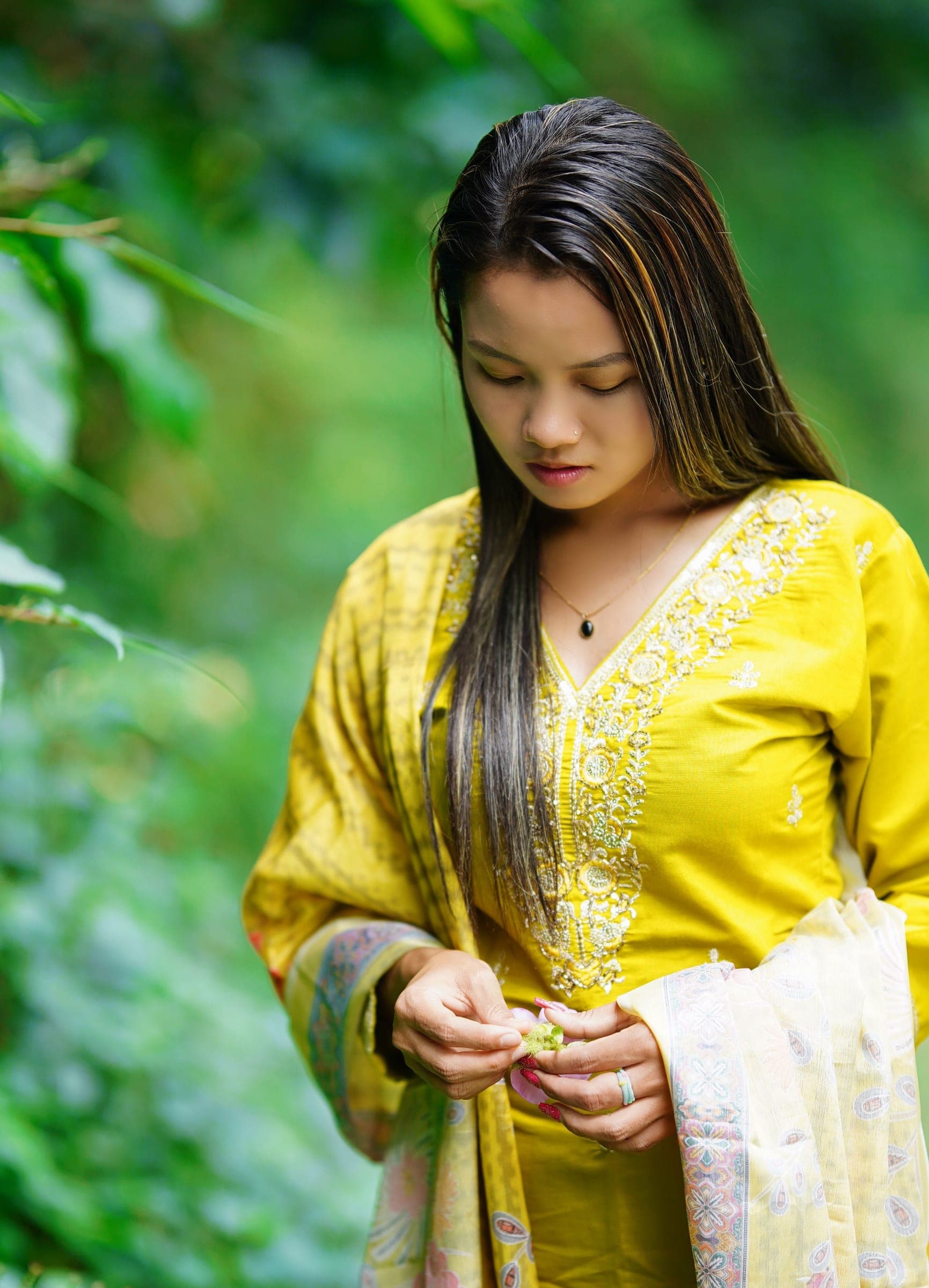
Find something whose size you know and compare. A shirt or kurta button is roughly a centimetre or so across. An adult fingertip is a little wider. A neckline opening, a sleeve cuff or the width of a dupatta border also gives you a sense of scale. If a motif is about three buttons wide, picture it at that size on your own outfit.
Photos of the outfit being worn help most of all, because the body gives everything a familiar scale.
Zoom in and look closely
Enlarge the clearest photo and check the edges of the motifs, where quality shows first. Look for even, smooth outlines, stitches lying in a consistent direction, and no backing or loose threads showing. Repeated motifs that are absolutely identical usually point to machine work; slight variation suggests hand work, as our machine or hand embroidery article explains. Make sure it really is stitched: some prints imitate embroidery convincingly at small sizes.
If you can, ask the seller for a close-up taken in daylight, a photo of the reverse and a picture of the piece being worn.
How it works when you order from us
Colours on our designs can look slightly different from the photos because of lighting, cameras and screens, and a small difference in shade is not a fault. For your own design, send a reference photo with a note of the size you want, and the design is agreed in writing before any work starts, as described in design approval. Ask for custom embroidery or start a design quote, and we confirm what is possible on your fabric and design.
Common questions
Why does embroidery look flatter in person than in the photo?
Product photos are often lit from the side to show texture, which makes raised stitches cast shadows. Under ordinary room light the same work looks flatter and softer.
Can I tell hand from machine embroidery in a photo?
Sometimes. Perfectly identical repeats and very even stitch lengths suggest machine work. Small differences between motifs suggest hand work, but a good close-up is needed to be sure.
Is a video more reliable than a photo?
Usually, yes. A short video in natural light shows how the thread catches the light, how the fabric moves and how raised the work is, which still photos often hide.
More guides
- Choosing embroidery placement for a suit, piece by piece
- Embroidery on organza: crisp, sheer and delicate
- What is jaal embroidery? All-over patterns explained
- Types of lace for suits: names, looks and uses
- Embroidered trouser hems: what a paincha can carry
- What is kantha embroidery? Running stitch explained