Unstitched suits · 8 October 2026 · 3 min read
Right side and wrong side of fabric: how to tell
Right side vs wrong side of fabric: what the face and back (seedha and ulta) are, checks for prints, satin, jacquard and plain cloth, and when to mark your side.
 Inspiration
Face and back
The right side of a fabric, also called the face, is the side meant to be seen on the finished garment. The wrong side, or back, faces inwards towards the body or the lining. In Urdu the same idea is seedha and ulta: seedha is the right way round, ulta is reversed or inside out, as in “kapra ulta hai”, the cloth is the wrong way out.
On many fabrics the difference is obvious. On others it is subtle, and on some plain weaves there is no real difference at all. A few cloths are made to be reversible on purpose.
Printed fabric
On a print, the face is almost always the side where the colours are sharpest and brightest. The back looks paler and slightly blurred, and on digitally printed cloth it may be nearly white. Block and screen prints sometimes soak through more, so the back can look like a faded copy of the front. Our article on block, digital and screen prints explains why each method looks different from behind.
Satin, jacquard, embroidered and textured cloth
These fabrics are built with a face, so the clues are usually clear once you know what to look for. Our jacquard fabric guide goes further on woven patterns.
- Satin: the shiny side is the face and the dull side the back, although some designs use the matte side deliberately.
- Jacquard: the pattern is crisper on the face; the back often shows the colours reversed or long loose floats of thread.
- Embroidered fabric: the face has the neat stitches, while the back shows knots, carried threads and sometimes a backing.
- Velvet and other pile fabrics: the pile is on the face and the back is a plain woven base.
- Twill: the diagonal lines usually stand out more clearly on the face.
Plain weaves and the harder cases
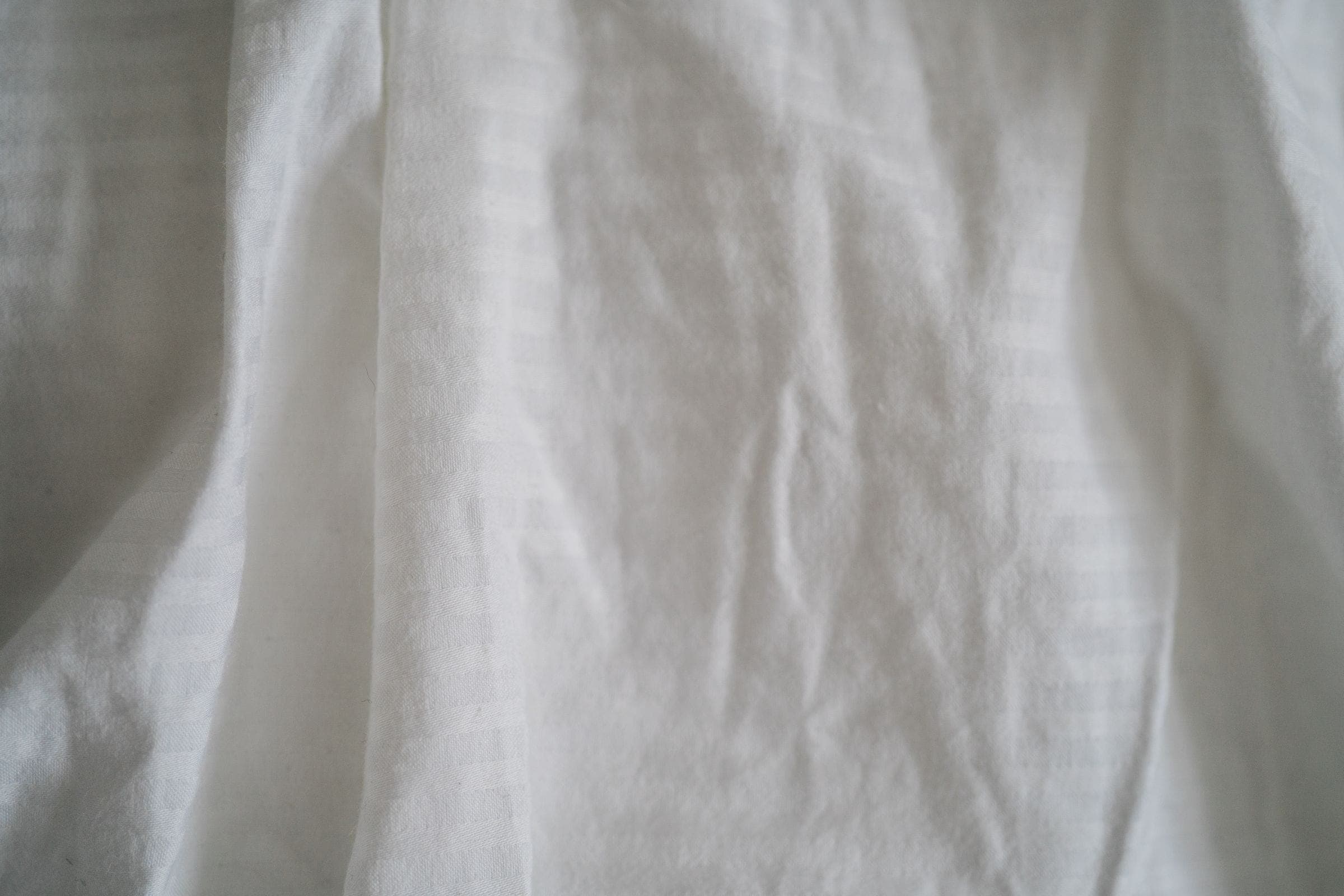
Plain-dyed lawn, cambric, voile and similar cloths often look the same on both sides. A few clues can help. Writing on the selvedge usually reads correctly on the face. The face may feel slightly smoother because finishes are applied to that side. Cloth is often folded or rolled with the face inwards to protect it, though not always. If you still cannot tell, it usually does not matter which side faces out, as long as every piece of the garment uses the same one, because small differences in sheen can show in daylight.
When to mark the side you want
Mark the fabric when you prefer the back, when both sides look alike but you have a preference, or when the outfit includes loose pieces such as borders and patches. A small safety pin or a strip of low-tack tape on the back corner of each piece works; avoid pens or chalk that could mark the cloth. Say in your enquiry what the mark means, and photograph both sides in daylight as shown in how to photograph fabric for a quote.
With Stitching Only, we confirm the fabric is suitable before you post it, and how to post your fabric for stitching covers packing. Start a stitching-only quote with your photos.
Common questions
Can I use the wrong side of a fabric on purpose?
Yes. The back of a print or jacquard often has a softer, more muted look, and it is sometimes used for contrast panels or a quieter outfit. Say so clearly in your order and mark the pieces.
What if both sides look exactly the same?
Then either side can face out, as long as every piece uses the same one. Mixed pieces can show small differences in sheen in daylight.
Is the face always folded inwards on a roll?
Often, to protect it from dust and fading, but not always. Treat the fold as a hint and confirm it with the other checks.