Embroidery and fancy work · 8 October 2026 · 3 min read
Embroidered front panel: centre strip, yoke or full
Front panel embroidery on a kameez: a centre strip, a yoke-depth panel or a fully worked front. How each changes proportion and weight, and what to ask for.
 Inspiration
Three ways to work the front
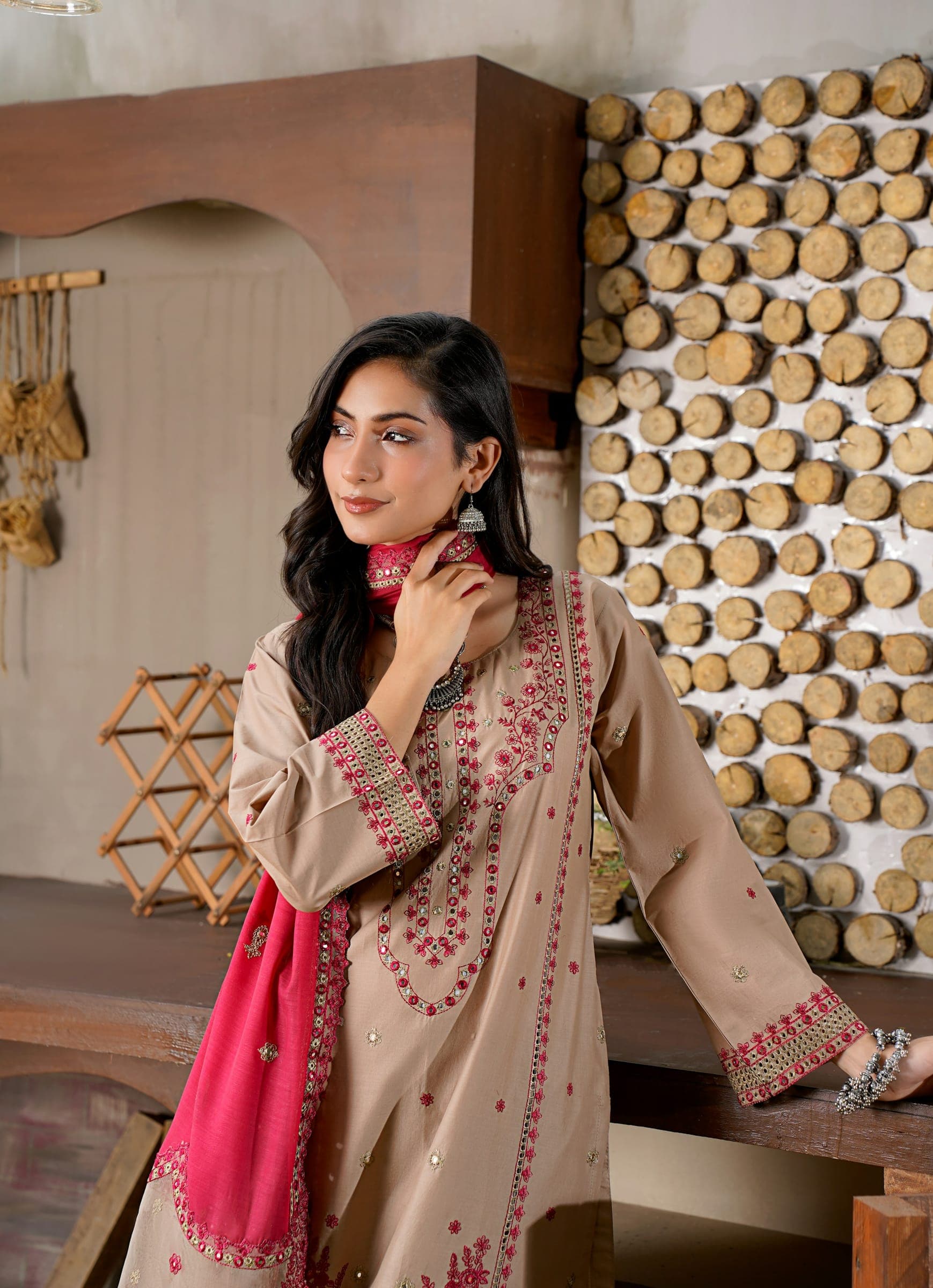
Front panel embroidery on a kameez comes in three main layouts: a narrow strip down the centre, a panel that covers the chest to yoke depth, or a front worked from shoulder to hem. The strip lengthens and stays light, the yoke frames the face and upper body, and the full front makes the richest statement but adds the most weight.
Our placement guide covers the neckline, sleeves and hem. This article is about the area between them.
The centre strip
A centre panel runs from the neckline towards the hem, usually a few inches wide, often following a placket or a neckline slit. It can stop at the waist, at the hip or run from neck to hem.
- Proportion: a strong vertical line, so it makes the body look longer and narrower. Useful on petite frames and on a long kameez.
- Weight: little. The side panels stay plain and the kameez keeps its drape.
- Watch for: it must sit exactly on the centre line and hang straight, since any lean shows at once. A strip that ends at the fullest part of the stomach draws the eye there, so end it higher or take it to the hem.
- Works with: a round neck with slit, a band collar or a buttoned placket.
The yoke-depth panel
A yoke panel spreads from the neckline across the upper chest and stops somewhere between the bust line and the waist, with a straight, pointed or curved lower edge.
- Proportion: it draws attention upward, towards the face and shoulders. A pointed or V-shaped lower edge is more lengthening than a straight one.
- Weight: moderate, and it rests on the shoulders, which makes it comfortable to wear.
- Watch for: a straight edge sitting right on the fullest part of the bust is the least flattering place for it to end. Slightly above or clearly below is easier.
- Works with: most cuts. Our article on yokes and panels shows how a yoke can be a separate piece of fabric as well as a worked area.
The fully worked front
Here the whole front, from shoulders to hem, carries embroidery, often an all-over pattern of the kind explained in our jaal guide. The back is usually plain or lightly worked.
- Proportion: the front reads as one rich surface, so the cut should be simple. Straight and gently A-line shapes show it well.
- Weight: the most of the three. A front much heavier than the back can pull the kameez forward and make the hem dip, so a lining and a fabric with some body help it hang level.
- Comfort: a large embroidered area is firmer when you sit and has a rough reverse, so lining is usually needed.
- Care: gentler washing and flat storage.
Decide before the work starts
Front embroidery is worked on the cut or marked front piece before the kameez is assembled, so the neckline shape, the finished length, the slit height and any front opening must be final first. A change of length afterwards moves where the panel ends. This is why the design is agreed in writing before cutting; our page on design approval explains that step.
Which level to ask for
On our quote form, embroidery is chosen by level: delicate, detailed or statement. As a rough guide, a slim centre strip sits near the delicate end, a yoke-depth panel is detailed work, and a fully worked front is statement work. Say which layout you want, how wide or deep it should be in inches or centimetres, and whether the sleeves and hem should match. Send a photo through the Send Your Design form, and we confirm what is possible on your fabric and design in the written quote. The custom embroidery page explains the levels.
Common questions
Does a fully embroidered front need lining?
Usually, yes. The reverse of the work covers the whole front of the body, and a lining makes it comfortable and helps the heavier front hang evenly with the back.
Should the back of the kameez be embroidered too?
It does not need to be. A plain back is more comfortable to sit in and keeps the outfit lighter. A small motif below the back neckline is a common compromise.
Can a centre panel hide a front opening?
Yes. A buttoned or concealed placket can run down the middle of a centre strip, which is useful for nursing or simply for getting the kameez on easily. Mention it when you describe the design.
More guides
- Choosing embroidery placement for a suit, piece by piece
- Embroidery on organza: crisp, sheer and delicate
- What is jaal embroidery? All-over patterns explained
- Types of lace for suits: names, looks and uses
- Embroidered trouser hems: what a paincha can carry
- What is kantha embroidery? Running stitch explained